
6 min read · Published October 24, 2026
Published by Ground & Return
Prepared and published through Ground & Return’s automated editorial process, including generative AI. It was not individually written or reviewed by Amit Gaur. Read our editorial policy.
How to breathe during yoga
Breathe through the nose, at the pace the breath sets for itself, and let it keep moving rather than holding it or shaping it into a technique. The reason is that a beginner pose needs attention on its arrangement, not on a breathing method: alignment-based guidance asks for breathing through the nostrils rather than the mouth, and it leaves breath control until students have a firm foundation of poses. If you have asthma, a heart or lung condition, or a clinician's instruction about your breathing, that is a question for a health professional and a qualified teacher rather than a rule to take from an article.
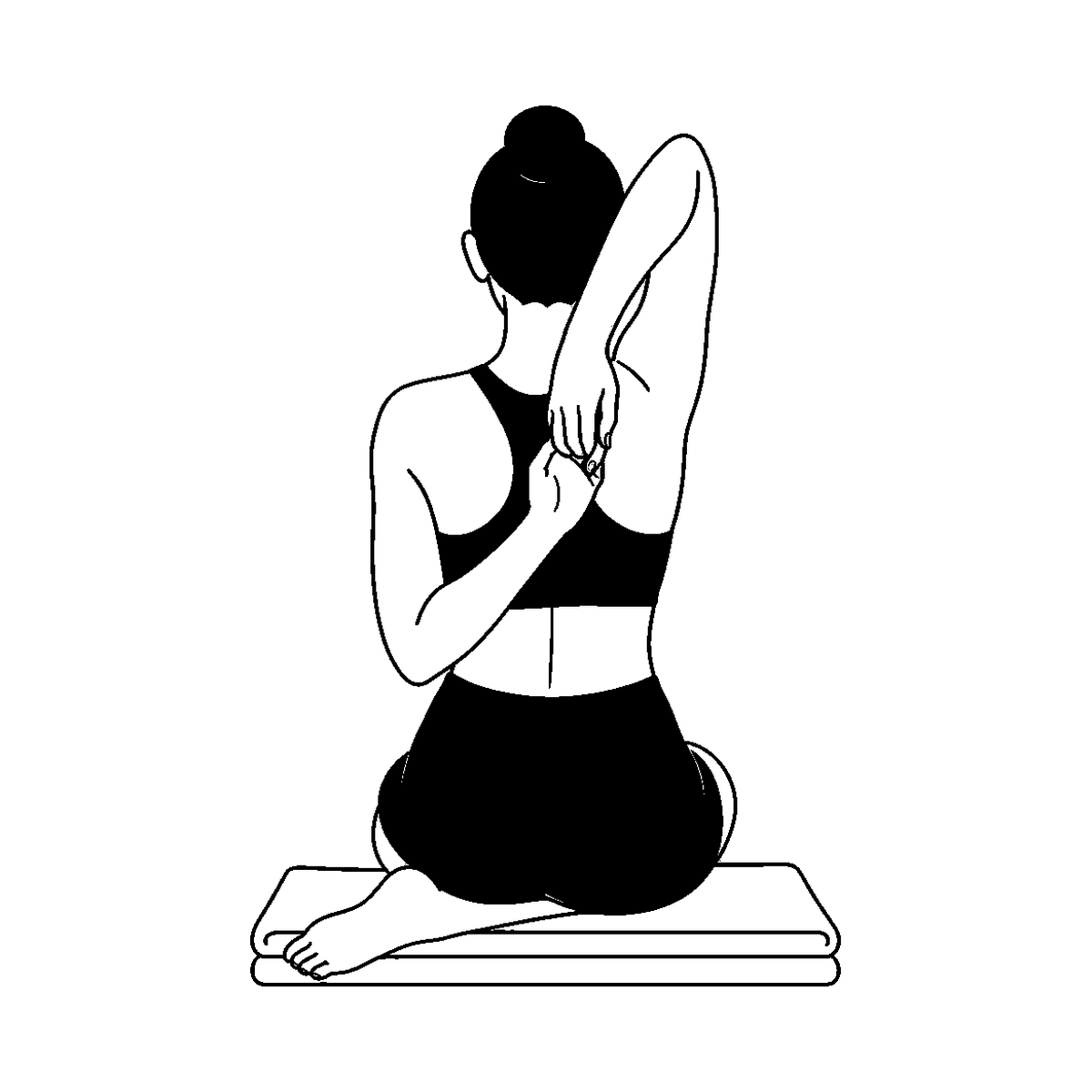
Cow Face
Gomukhāsana
The short answer, and what the guidance says
The short answer is that a beginner does not need a breathing method to practise poses. The breath that suits a beginner pose is an ordinary one, taken through the nose and left to find its own pace, while attention goes to what the instruction describes: where the feet go, what the legs and spine are doing, and how the pose is entered and left. Breathing is not a skill to perfect before the poses can begin.
IYNAUS, on its page about home practice for beginners, lists a few hints for practising asanas drawn from B.K.S. Iyengar's Light on Yoga, and one of them is that in all asanas the breathing should be done through the nostrils only and not through the mouth. It is the only hint on that list about the breath. Ground & Return is independent and is not affiliated with the Iyengar Yoga Institute of New York, IYNAUS, or any Iyengar Yoga organization.
Iyengar Yoga UK supplies the other half. In its guidance for people starting classes, it says that teachers gradually introduce pranayama, or breath control, once students have a firm foundation of asana practice, and that students usually begin pranayama after about two years of regular asana practice. So the beginner's question is narrower than it looks: not which technique to use, but how to let ordinary breathing carry on while the poses are learned.
Breathing in a pose is not a breathing exercise
It helps to separate two things that are often taught side by side. The National Center for Complementary and Integrative Health notes that yoga as practised in the United States typically emphasizes physical postures, breathing techniques, and meditation, distinct elements even when one class contains all three. A breathing technique is something done to the breath: lengthening it, counting it, or shaping it in a set way. Breathing in a pose is breathing while the body does something else.
Asking a beginner to do both at once, learning a new pose while managing the breath in a particular way, divides attention between two kinds of instruction. Alignment-based teaching puts the two in order instead. The poses come first, and breath control is added once there is a firm base of asana practice, which is a decision about sequence rather than a sign that the breath does not matter.
There is one place where the two meet early. Iyengar Yoga UK says that observation of normal breathing patterns, and some basic pranayama, may be introduced during the relaxation at the end of an asana class. Observation is the word that matters for a beginner at home: noticing the breath belongs to practising poses, while changing it on purpose is a separate practice with its own instruction, introduced by a teacher.
Through the nose, and when the mouth opens
In quiet poses the nostril rule is easy to keep. Standing evenly, sitting upright, folding forward without strain, and lying in rest can all be done with the mouth closed and the breath passing through the nose. In poses like these the rule is less an instruction to do something new than an instruction not to change what the breath was already doing.
The rule earns its place at the moments the mouth opens on its own. If you find yourself breathing through the mouth in a demanding pose, a slipping balance, or a hurried transition, treat that as information about the effort rather than a lapse to correct by force. The useful response is usually to ease the pose a little, so that the breath can return to the nose, rather than to clamp the mouth shut and carry on.
Some days the rule is harder to keep for ordinary reasons, such as a cold or a blocked nose, and those are not a reason to strain. If breathing through the nose is difficult for you more often than not, take that to a health professional. Iyengar Yoga UK asks new students to tell the teacher about medical conditions, heart problems and high or low blood pressure among them, so that the teacher can offer adaptations or alternative poses.
Holding the breath, and what it tells you
A second habit is holding the breath altogether. It is easy to do without noticing, particularly at moments of effort or uncertainty: lifting into a pose, catching a balance, turning in a twist, coming up from a forward bend. Sometimes the only sign is a long exhalation once the pose is over.
A held breath is better read as information about the pose than as a fault in the breathing. It can mean the pose is being held together by effort the instruction did not ask for: gripping, bracing, or pushing toward a shape the body has not yet arrived at. Letting the breath continue usually means doing a little less, and in beginner work that is the correct adjustment rather than a concession.
The illustration on this page shows Cow Face, a seated pose taken on a folded blanket, with one arm reaching down over the shoulder and the other up behind the back until the hands meet. A pose like this asks a good deal of the shoulders while the rest of the body sits still, which makes it a good place to check the breath. You do not need to practise it for the point to hold; in beginner work, whatever the pose, the breath should still be moving at the end of it.
Watching the breath without managing it
The same IYNAUS list describes the attitude that suits the breath in a pose. During the practice of asanas, it says, the body alone should be active, while the brain remains passive, watchful, and alert. Applied to the breath, that means watching it the way you might watch the feet in a standing pose: noticing what it does, without taking it over and making it one more thing to perform.
The list also says that in the beginning you should keep your eyes open, which pairs naturally with the breath. Eyes open on the room and the pose, the breath continuing in the background, and attention on the instruction is a workable arrangement for a beginner at home. Closing the eyes to concentrate on breathing turns a pose into a different practice, and it is not what the beginner guidance asks for.
Iyengar Yoga UK describes the relationship from the side of the pose. Explaining what students can expect in a class, it says that if the body is aligned with precision, then the breath is aligned with the same precision. For a beginner, that is a practical reason to spend attention on the arrangement of the pose and let the breath follow it, rather than trying to repair a difficult pose by working on the breath.
Breathing exercises can wait for a teacher
Breathing exercises are easy to find in apps, videos, and articles. For a beginner practising at home, they belong with the material that published guidance says to leave for supervision. The National Center for Complementary and Integrative Health advises people who are new to yoga to avoid extreme practices, and it names forceful breathing on that list alongside headstands, shoulder stands, and the lotus position.
The Iyengar Yoga Institute of New York's home-practice guidance gives a rule that covers this case. If something does not feel right, it says, stop, and save the poses you do not feel confident with for class, where you can be supervised. A breathing technique learned from a screen belongs in that second group, however gentle it sounds. Ground & Return is independent and is not affiliated with the Iyengar Yoga Institute of New York, IYNAUS, or any Iyengar Yoga organization.
When breath control is taught, it is normally taught as a practice in its own right, in a class Iyengar Yoga UK describes as designed specifically for it. IYNAUS is explicit that general home-practice material does not suit every person or condition, and it directs open questions to a certified teacher. At home, practise the poses you have been taught, notice the ordinary breath while you do, and leave breath control until a teacher introduces it.
When the breath is a reason to stop
Some changes in the breath end a session rather than adjust it. Breathlessness that does not settle when you come out of a pose, light-headedness, or discomfort in the chest mean the session should stop, and each is a reason to seek medical advice rather than something to work through. Pain, sharpness, numbness, dizziness, and instability are reasons to come out of a pose calmly and stop.
The National Center for Complementary and Integrative Health advises practising with qualified guidance and taking extra care if you are new to yoga or have individual health considerations. It also says that people with health conditions should talk with their health care providers and the yoga instructor about their individual needs, because some poses and practices may need to be avoided or modified. A condition that affects your breathing, or a medication that does, is plainly in that group.
NCCIH also notes that learning yoga on your own without supervision has been associated with increased risks, which is a good reason to keep home practice to material you have been taught and to bring questions about the breath to a teacher who can watch you practise. Yoga, and any app that carries it, should never be used to postpone medical care.
How Ground & Return fits around the breath
Ground & Return is an iPhone app built around one complete 28-week syllabus of 196 daily sessions, with 110 illustrated pose references and method notes beside them. Pacing is manual, so a session moves when you move rather than when a timer decides, and nothing advances while you pause between poses to let the breath settle. The core material is available offline, progress and practice notes stay on the device, there is no account and no subscription, and a daily reminder is optional.
What it cannot do is the part this question turns on. The app cannot hear your breath, tell whether you are holding it or breathing through the mouth, judge whether a pose is asking too much of you today, or teach breath control. It holds the sequence, the pose references, and your place in the path; questions about breathing in a pose belong to a qualified teacher, and anything involving breathlessness, a heart or lung condition, or another health concern belongs with a health professional.
Three common questions
Should you breathe through your nose or your mouth during yoga? Through the nose. Among the hints IYNAUS gives for practising asanas is that the breathing should be done through the nostrils only and not through the mouth. If your mouth opens on its own during a pose, take it as a reason to ease the effort, and if breathing through the nose is difficult for you in general, ask a health professional.
Is it bad to hold your breath during yoga? In beginner poses a held breath is better read as a signal than kept as a habit. If the breath stops, the pose may be held together by more effort than the instruction asked for, so do a little less until the breath moves again. If your material tells you when to breathe in or out as you move into or out of a pose, follow that.
When should a beginner start pranayama? When a teacher introduces it. Iyengar Yoga UK says pranayama is brought in gradually once students have a firm foundation of asana practice, usually after about two years of regular practice, and taught in a class designed for it. Until then, noticing the ordinary breath at rest is enough, and NCCIH advises people new to yoga to avoid forceful breathing.
The plain answer is unglamorous: breathe through the nose, let the breath keep its own pace, treat a held breath as a reason to do less, and leave breath control to a qualified teacher and anything about your breathing itself to a health professional.
