

6 min read · Published October 10, 2026
Published by Ground & Return
Prepared and published through Ground & Return’s automated editorial process, including generative AI. It was not individually written or reviewed by Amit Gaur. Read our editorial policy.
How long after eating to practice yoga
Published yoga instruction generally asks for a relatively empty stomach: roughly two to four hours after a full meal, and about an hour after something light. The reason is practical rather than ceremonial — forward bends, twists, and anything that compresses or inverts the abdomen behave differently on a full one. If the material you practise from gives its own figure, use that figure rather than a general one. And if the gap cannot be arranged on a given day, the useful adjustment is to practise something that suits the state you are in, which is a question for whoever teaches you rather than for a clock.
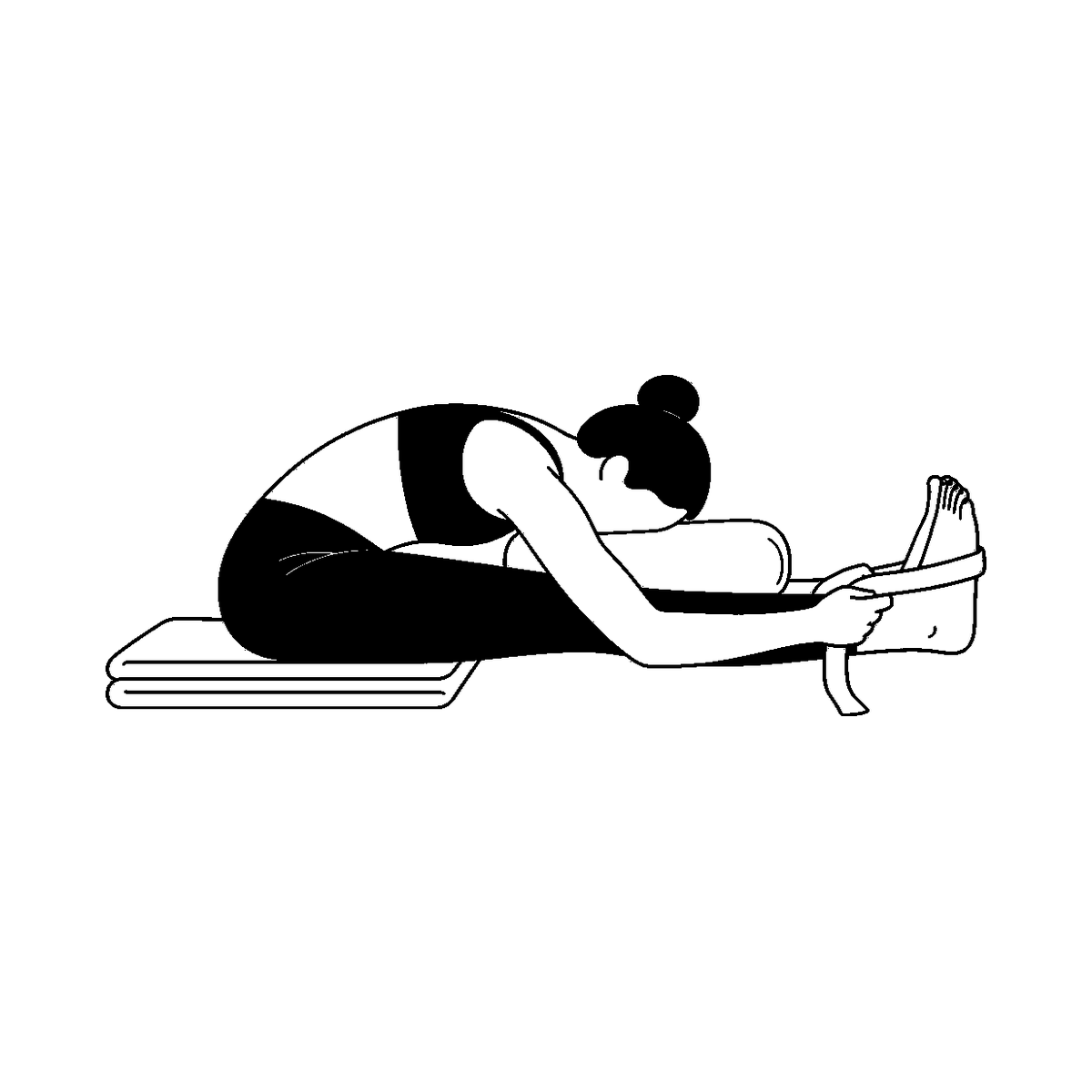
Seated Forward Bend
Paścimottānāsana
The usual answer, and where it comes from
The figure most often given for a full meal is two to four hours, and for a light snack about an hour. It is a range rather than a number because meals differ, bodies differ, and the practice you are about to do differs; a sequence of standing poses and a long rest is not the same proposition as one built around deep forward bends. The range is a working guide, not a threshold that makes a practice safe on one side and unsafe on the other.
What sits underneath the guidance is simple mechanics. A good deal of beginner asana folds the torso forward, turns it, or asks the abdomen to be long and unhurried, and a stomach in the middle of its work makes all three uncomfortable in a way that has nothing to do with effort or skill. Discomfort of that kind tends to be read as a failure of the pose, and the adjustment people make is usually to push, which is the wrong correction.
It is worth noticing that the instruction is about the state of the stomach rather than about food as such. Someone who ate a small bowl of something three hours ago and someone who ate a large dinner three hours ago are not in the same condition, and the clock is the less informative of the two facts. The practical test is whether you can fold forward and breathe ordinarily, not whether the required number of hours has elapsed.
What a full stomach changes inside a pose
Seated forward bends show the effect most plainly. A pose like Seated Forward Bend asks the front of the body to lengthen and the torso to come toward the legs, and on a full stomach the fold stops earlier and the breath shortens sooner. Nothing is wrong with the body; the pose simply has less room to happen in, and the honest version of it today is a shorter one.
Twists and compressive poses behave the same way for the same reason, and inversions add their own problem, which is that the arrangement of the abdomen changes when it is no longer the right way up. This is one of the reasons published material tends to treat inversions as supervised territory for beginners rather than as poses to approach from a description, and the meal question only sharpens that.
The reason this matters beyond comfort is that discomfort distorts instruction. A pose entered while the abdomen objects is a pose where attention goes to the objection rather than to the arrangement the instruction described, and a practice spent negotiating with a meal is not the practice that was written down. The waiting is not about purity; it is about being able to follow what you were taught.
Arranging the practice around the meal, not the meal around the clock
For most home practitioners the question resolves into a choice of slot rather than a calculation. Practising before breakfast makes the gap automatic, which is a large part of why early practice is so often recommended for beginners: the condition the instruction asks for is simply the condition you wake up in. The cost is that mornings are stiffer, and the response to that is pace rather than extra material.
An evening practice is perfectly ordinary too, but it needs the day arranged slightly differently — eating earlier, or eating lightly and leaving the larger meal until afterwards. People who try to put a practice straight after dinner usually abandon it within a few weeks, and they generally conclude that evening practice does not suit them when what did not suit them was the order of the two things.
The useful move is to pick the slot where the gap already exists in your week, rather than the slot that sounds best and then defending it against your meals. A practice that requires the day to be rearranged every time is a practice with a built-in reason to be skipped, and that is a far more common cause of a home practice ending than any single pose is.
Water, tea, and something small beforehand
Water is a separate question from food and is generally treated as such: ordinary sips before practice are unremarkable, while a large quantity immediately beforehand produces the same abdominal fullness that the guidance about meals is concerned with. The same goes for a mug of tea or coffee taken on the way to the mat, and the only real test is whether a forward bend is comfortable a few minutes later.
Something small is a reasonable compromise when practising on a genuinely empty stomach leaves you light-headed or weak, which happens to some people, particularly early in the morning. A little food an hour or so before, chosen so that it has somewhere to go by the time practice begins, is a common arrangement. If light-headedness is a recurring feature of your practice rather than an occasional one, that belongs with a health professional rather than with an adjustment to your schedule.
What to avoid is the habit of treating food as a way to make a practice feel better mid-session. Stopping partway through to eat something, then resuming, turns one session into two shorter and less coherent ones, and the information that the day's practice was badly timed gets lost. Note it instead, and move the slot next time.
Why this is a question for your material and your teacher
The gap you should leave depends on what you are about to practise, and only your own material knows that. A syllabus that places deep forward bends or inversions in a given week implies a different degree of care about meals than one built around standing poses and rest, and a published course or a certified teacher can tell you which of those you are in. A general figure found online cannot.
The Iyengar Yoga Institute of New York points home practitioners toward poses they already know from class and leaves anything uncertain for a teacher and a supervised setting. Whether a particular pose is appropriate for you in the condition you are in today falls squarely into that second category, even when the uncertainty is about a meal rather than about the pose itself. Ground & Return is independent and is not affiliated with the Iyengar Yoga Institute of New York, IYNAUS, or any Iyengar Yoga organization.
There is also a category of individual circumstance that no general guidance covers: digestive conditions, medication taken with food, pregnancy, blood-sugar management, and anything a clinician has already given you instructions about. In all of those cases the instruction you already have outranks the usual yoga advice, and the two should be reconciled by the people qualified to do it rather than by you choosing between them.
When the gap cannot be arranged
Some days will not provide two to four hours of clear stomach at any point you are also free to practise. The choice then is not between practising the usual sequence and practising nothing. It is between practising something that suits the day, chosen from material you have already been taught, and forcing the usual sequence into a body that is busy with something else.
IYNAUS is explicit that general home-practice material does not suit every person or condition, and it directs open questions to a certified teacher. What to substitute when a meal makes the day's session unsuitable is exactly such a question, because the answer depends on what you have been taught and what your syllabus is asking for that week rather than on a rule that could be stated here. Ground & Return is independent and is not affiliated with the Iyengar Yoga Institute of New York, IYNAUS, or any Iyengar Yoga organization.
Until you have asked, the conservative version is to wait rather than to improvise, and to let the session be late or be missed. A practice is built over months, and one session moved for a meal costs nothing measurable. Inventing a substitute sequence in order to protect an unbroken streak is a larger change to a practice than the gap it was covering.
Signals that end a session regardless of timing
Nausea, reflux, cramping, light-headedness, or abdominal discomfort that does not settle are reasons to come out of a pose calmly and stop, whether or not the recommended hours have passed. They are information about today rather than a problem to work through, and the belief that a feeling will pass if you continue is a common route to a worse session and occasionally to an injury.
The National Center for Complementary and Integrative Health advises practising with qualified guidance and taking extra care if you are new to yoga or have individual health considerations. Pain, sharpness, numbness, dizziness, and instability mean the same thing in this context as in any other: stop, and take the question to an appropriately qualified teacher or a health professional. Yoga, and any app that carries it, should never be used to postpone medical care.
There is also a slower signal worth watching for, which is the session that feels heavy or uncomfortable in the same way week after week. That pattern is usually about the timing of the practice within the day rather than about any single pose, and it is best approached by writing down what was eaten and when, then asking someone qualified to read it with you.
How Ground & Return fits practice around meals
Ground & Return is an iPhone app built around one complete 28-week syllabus of 196 daily sessions, with 110 illustrated pose references and method notes beside them. Pacing is manual, so a session waits where you left it rather than advancing on a timer, and an optional daily reminder can be set for whatever time of day your meals actually leave free. The core material is available offline, progress and practice notes stay on the device, there is no account and no subscription, and completed sessions can optionally be saved to Apple Health.
What it cannot do is the part this question turns on. The app does not know what you ate or when, cannot tell that a forward bend is being limited by a meal rather than by your hamstrings, cannot judge how long you in particular should leave, and cannot decide that today's session should be postponed or replaced. It holds the sequence, the pose references, and your place in the path; judgements about practising around meals belong to a qualified teacher, and anything involving digestion, medication, or another health consideration belongs with a health professional.
Three common questions
Can you do yoga right after eating? It is generally advised against, and the discomfort is usually its own argument: forward bends, twists, and inversions all feel wrong on a full stomach, and the shapes they produce are not the ones the instruction described. If you have only just eaten and only this moment free, waiting and practising later in the day is the ordinary answer.
Is it better to do yoga before or after breakfast? Before is the simpler arrangement, because the gap the guidance asks for is already there and nothing has to be scheduled around it. After breakfast is fine too, with about an hour's distance from something light, and the choice between them is better settled by which one you will actually keep doing than by which is theoretically preferable.
Should you practise on a completely empty stomach? Not necessarily, and not if it leaves you weak or light-headed. Empty is a direction rather than a requirement, and something small an hour beforehand is a common and unremarkable adjustment. A persistent need for food in order to practise at all is a question for a health professional rather than a detail of scheduling.
The plain answer is unglamorous: leave a few hours after a full meal and about an hour after something light, practise at the time of day your meals already leave free, and let a qualified teacher settle what to do on the days the gap is not there.
